Tuesday, April 24, 2018
Understanding Our DNA Tests
Nadene Goldfoot
Edited by Dr. Sandra Oster
We have 23 chromosomes that carry our genes. The chromosomes are like steps on a ladder, with #1 being the widest step that holds the most genes. The 23rd and last step is called either the X match which means they have a female match in common or a Y match meaning they have a male match in common. It's the sex gene which determines our own sex. Females have XX. Males have XY. The Y chromosome has the fewest genes; only 231.
All 23 rungs on the ladder which stand for the 23 chromosomes we have carry double amounts in 2 rows. One row is from our father and the other from our mother. It's pretty close to being even; 50-50. Our test from FTDNA has been identifying if a match is from either parent with a little icon of a blue male or red female or purple from both; like the child would have. Some people cannot be decided on and get no icon by their name/picture.
 The genes come to us in little 1cM blocks, like a single Lego block. In genetics, a centimorgan is a measurement for distance. It is (abbreviated cM) or map unit (m.u.) is a unit for measuring genetic linkage. It is defined as the distance between chromosome positions (also termed loci or markers) for which the expected average number of intervening chromosomal crossovers in a single generation is 0.01. The thing is, they usually come to us stuck together with others, making a longer block called a segment. The longer the segment, the closer you are to the person you match with them. 1 lego block is 1cM.
 The ladder is seen by the scientists as a twisted ladder, the shape of a double helix.

Here's my test result with a 1st paternal cousin.
Notice the segments are pretty long, several on one chromosome. #1 chromosome has 4 segments.
I don't worry about the SNPs (Single Nucleotide Ploymorphisms.) They are a very slowly mutating location that is used to define haplogroups, another factor of genetics. That is important in identifying the clans your father or your mother belonged to.
The largest segment is on #9 chromosome. of 52.1cMs. Look below at chromosome #9. It's a picture of the largest segment being in this case, a long one of 52.1. It a length of 52.1 little blocks stuck together.
The smallest segment is on #21 of 7.5cMs.
A segment of 5cMs and more is counted as an important fact. Some people only get interested in the facts with a segment of 7cMs and more. . Smaller segments are not too important, possibly thought of as not as reliable scientifically.
The graph on FTDNA showing #1 chromosome match between my 1st cousin and myself: This black and yellow length is a chromosome with yellow segments on it and is the first chromosome called #1. When you are on your page in Family Tree DNA's website, you would see this and all the other 22 chromosomes. I'm showing you this one because the table below shows 4 large segments on #1 chromosome listed separately with the start and end location and how many cMs they have as well as how many SNPs that chromosome has..


 The Table-below
Largest segment = 52.1 cM
Total of segments > 7 cM = 837.6 cM
37 matching segments
Estimated number of generations to MRCA = 2.0 MOST RECENT COMMON ANCESTOR
Here's the test with the same cousin and my daughter to see what she inherited .
How did she match the #3 chromosome? I didn't have a match on #3 so how could she inherit it from me? I thought I pass genes to my daughter. How did she inherit 7.1cMs on chromosome number 3? Wouldn't they have come from her father, then?
She inherited some segments in the same piece that I passed to her, but most had lost some cMs.in the passing to her.. She gained #3's matching chromosome segment that I didn't have, I thought.
My son did not have a match with my 1st cousin on #3.
Largest segment = 35.7 cM
Total of segments > 7 cM = 398.8 cM
23 matching segments
Estimated number of generations to MRCA = 2.6
My brother had inherited 2 large segments on chromosome #3 .They aren't the same segments that I had matched with our cousin and are big ones, too. Siblings don't always match the same segments with other people just because they are siblings.
.
Our Goldfoot Family Tree
Notice the unusual names below. They are how our ancestors were listed in the Lithuanian records. Every 10 years or so their names appeared in a different spelling of the first letter. ben means son of, which helped to identify their parents.
1 Iankel Yankel ben Abram Goldfusb: 1768 in Telsai, Telsiai, Kaunas, Lithuaniad: December 06, 1860 in Telsliai, Telsiai, Kaunas, Lithuania
..+Khana Unknownb: Abt. 1778 in Telsiai, Telsiai, Kaunas, Lithuania
.2 Abram Goldfusb: Abt. 1797 in Telsiai, Telsiai, Kaunas, Lithuania
.....3 Mendel Goldfusb: 1800
.....3 Leyba Abramov Goldfusb: 1819 in Papile, Siauliai, Kaunas, Lithuania
.........+Feyge Ioselevab: 1820
.....3 Ginda Abramovna Goldfusb: Abt. 1820 in Telsiai, Lithuaniad: January 15, 1869 in Telsiai, Lithuania
.....3 Golda Abramovna Goldfusb: 1836 in Telsiai, Lithuaniad: April 12, 1911 in Telsiai, Lithuania
.2 [3] Iosel Josel Symka ben Yankel Goldfusb: 1798 in Telsiai, Telsiai, Kaunas, Lithuania, Russiad: December 19, 1878 in Telsiai, Telsiai, Kaunas, LithuaniaOccupation: 1851 3rd guild merchant;
.....+Rashab: Abt. 1798 in Telsiai, Telsiai, Kaunas, Lithuania, Russiad: Bef. 1876 in Telsiai, Lithuania
.....3 [1] Avrohom Abraham Haim Goldfusb: Abt. 1820 in Telsiai/ Vilna, LithuaniaOccupation: Corn Merchant into Moscow
Our 3rd cousin match goes back to Iankel Yanken ben Abram Goldfus as his gggrandfather.
My 1st cousin and I go back to Iosel Josel Symka ben Yankel Goldfus as our gggrandfather. Iosel is the son of Iankel.
2 generations ago; grandfather-your father's father or your mother's father ...2 grandmothers, 2 grandfathers
3 generations ago; ggrandfather- your grandfather's father...... 4 ggrandmothers, 4 ggrandfathers
4 generations ago; gggrandfather-your ggrandfather's father 8 gggrandmothers, 8 gggrandfathers
5 generations ago; ggggrandfather: the white circle in the chart below, needed to find 4th cousins. Your gggrandfather's father. 16 ggggrandmothers and 16 ggggrandfathers
Chart to Find 4th Cousins
 Our 3rd cousin, another Goldfoot, matches like this:
1. Find your circle which is black. Your father is above YOU in green. His father is above the green and is red.
2. The red circle is your grandfather. Your father's brother had a child which is also green and labeled as 1C (first cousin).
3. To find a 2nd cousin, you must go to your grandfather's father which is blue on the chart.
The child of his brother would be the first cousin of your father's brother.
1C in the white circle's child is your 2nd cousin (2C).
On the above chart one can see how to locate a 1st, 2nd, 3rd and even a 4th cousin. Therefore, to find our 3rd cousin on our tree, we have to look at our gggrandfather (the orange) who is the father of our ggrandfather and his descendants. Iosel or Josel Symka ben Yankel Goldfus born 1798 should be our common ancestor.
Matching my 1st cousin
TRIANGULATION-on chromosome 2
216,044,195.......................................................................241,324,642 3rd cousin (47.8cMs)
193,071,967.................................... ...................219,949,518 my daughter(27.9cMs)
193,725,959...............................................................223,565,798 Me ( 33.9cMs)
When you share the same segment with 2 other people, this is called a triangulation.
You use triangulation in seeing who is part of your family.
Largest segment = 47.8 cM
Total of segments > 7 cM = 144.8 cM
8 matching segments
Estimated number of generations to MRCA = 3.3
Research: https://www.mrsec.psu.edu/sites/mrsec.psu.edu/files/dna_determines_your_appearance.pd
Book: DNA & Genealogy by Colleen Fitzpatrick & Andrew Yeiser
Edited by Dr. Sandra Oster
 |
| Think of our genes (which are a unit of heredity that is transferred from a parent to offspring and is held to determine some characteristic of the offspring.) sitting on a ladder with 23 pairs of rungs called chromosomes. One slat on the rung is from your mother, the other from your father. The first rung, called #1 is the widest rung on the ladder. It has 2,968 genes. There are 890 known diseases related to this chromosome. Some of these diseases area: hearing loss, Alzheimer disease, glaucoma and breast cancer. |
All 23 rungs on the ladder which stand for the 23 chromosomes we have carry double amounts in 2 rows. One row is from our father and the other from our mother. It's pretty close to being even; 50-50. Our test from FTDNA has been identifying if a match is from either parent with a little icon of a blue male or red female or purple from both; like the child would have. Some people cannot be decided on and get no icon by their name/picture.


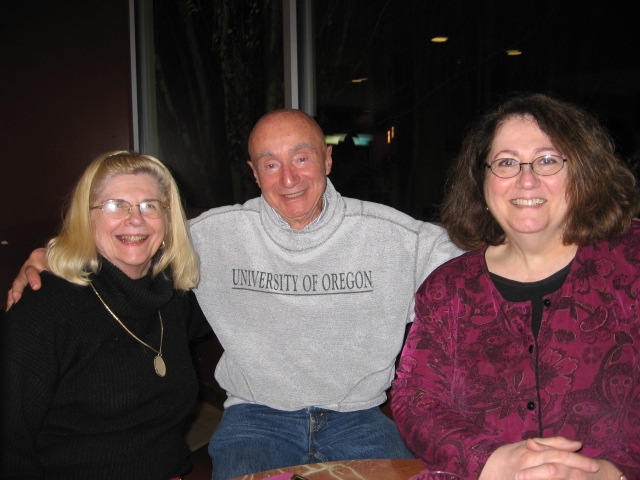 |
| Myself with two 1st paternal cousins. Only one has tested so far. The test from GedMatch.com shows we are a 2 generation match. True, we go back to our grandparents to find the common match. Our parents were siblings; my father with their mothers. Our grandparents had had 5 children with one who had died in infancy. |
Notice the segments are pretty long, several on one chromosome. #1 chromosome has 4 segments.
I don't worry about the SNPs (Single Nucleotide Ploymorphisms.) They are a very slowly mutating location that is used to define haplogroups, another factor of genetics. That is important in identifying the clans your father or your mother belonged to.
The largest segment is on #9 chromosome. of 52.1cMs. Look below at chromosome #9. It's a picture of the largest segment being in this case, a long one of 52.1. It a length of 52.1 little blocks stuck together.
The smallest segment is on #21 of 7.5cMs.
A segment of 5cMs and more is counted as an important fact. Some people only get interested in the facts with a segment of 7cMs and more. . Smaller segments are not too important, possibly thought of as not as reliable scientifically.
The graph on FTDNA showing #1 chromosome match between my 1st cousin and myself: This black and yellow length is a chromosome with yellow segments on it and is the first chromosome called #1. When you are on your page in Family Tree DNA's website, you would see this and all the other 22 chromosomes. I'm showing you this one because the table below shows 4 large segments on #1 chromosome listed separately with the start and end location and how many cMs they have as well as how many SNPs that chromosome has..
| Chr | Start Location | End Location | Centimorgans (cM) | SNPs |
| 1 | 3,052,221 | 25,801,522 | 44.8 | 6,612 |
| 1 | 53,581,281 | 69,237,989 | 22.1 | 4,484 |
| 1 | 74,788,735 | 90,271,128 | 14.6 | 3,815 |
| 1 | 149,227,054 | 163,867,989 | 21.2 | 4,088 |
| 2 | 84,202,139 | 106,046,373 | 10.3 | 3,041 |
| 2 | 193,725,959 | 223,565,798 | 33.9 | 6,378 |
| 2 | 223,581,059 | 233,766,809 | 14.4 | 2,341 |
| 4 | 61,566 | 6,048,415 | 10.4 | 1,413 |
| 4 | 139,776,818 | 173,159,377 | 34.4 | 6,286 |
| 5 | 2,711,026 | 9,426,448 | 17.1 | 2,343 |
| 5 | 29,372,002 | 55,864,542 | 23.0 | 4,971 |
| 5 | 153,966,655 | 180,623,543 | 45.7 | 6,994 |
| 6 | 3,653,477 | 20,272,175 | 32.2 | 4,958 |
| 6 | 74,007,746 | 91,078,586 | 10.5 | 3,373 |
| 6 | 126,393,744 | 137,403,363 | 11.6 | 2,349 |
| 6 | 154,838,664 | 161,802,211 | 9.6 | 2,104 |
| 7 | 29,887,885 | 45,266,280 | 19.7 | 3,835 |
| 8 | 6,006,187 | 12,761,447 | 11.6 | 1,917 |
| 8 | 23,060,574 | 31,234,783 | 11.9 | 2,354 |
| 8 | 103,773,672 | 125,812,954 | 19.0 | 4,408 |
| 9 | 81,797,685 | 123,377,583 | 52.1 | 10,912 |
| 9 | 124,006,082 | 134,328,607 | 15.2 | 2,497 |
| 10 | 85,994,218 | 103,089,567 | 16.5 | 4,577 |
| 10 | 128,065,109 | 135,297,961 | 18.9 | 2,714 |
| 12 | 116,636,547 | 124,168,929 | 9.3 | 1,758 |
| 14 | 30,341,495 | 42,197,431 | 16.8 | 2,771 |
| 14 | 89,899,082 | 106,345,097 | 34.6 | 4,453 |
| 15 | 18,331,687 | 40,097,819 | 42.3 | 5,070 |
| 16 | 64,956,434 | 80,257,464 | 22.4 | 4,230 |
| 17 | 12,344 | 7,964,962 | 22.0 | 2,537 |
| 18 | 6,414,209 | 32,274,392 | 40.6 | 6,428 |
| 18 | 71,869,832 | 74,401,062 | 8.0 | 971 |
| 19 | 3,713,698 | 33,398,855 | 36.2 | 5,038 |
| 20 | 57,539,142 | 62,374,274 | 16.5 | 1,588 |
| 21 | 9,849,404 | 16,035,905 | 7.5 | 569 |
| 21 | 16,591,440 | 35,444,863 | 32.8 | 5,231 |
| 22 | 37,722,196 | 49,528,625 | 28.0 | 3,818 |
Total of segments > 7 cM = 837.6 cM
37 matching segments
Estimated number of generations to MRCA = 2.0 MOST RECENT COMMON ANCESTOR
Here's the test with the same cousin and my daughter to see what she inherited .
How did she match the #3 chromosome? I didn't have a match on #3 so how could she inherit it from me? I thought I pass genes to my daughter. How did she inherit 7.1cMs on chromosome number 3? Wouldn't they have come from her father, then?
She inherited some segments in the same piece that I passed to her, but most had lost some cMs.in the passing to her.. She gained #3's matching chromosome segment that I didn't have, I thought.
My son did not have a match with my 1st cousin on #3.
| Chr | Start Location | End Location | Centimorgans (cM) | SNPs |
| 1 | 3,025,087 | 12,086,665 | 19.3 | 2,788 |
| 1 | 74,942,731 | 90,347,366 | 14.6 | 3,835 |
| 1 | 149,581,003 | 163,732,848 | 20.9 | 3,965 |
| 2 | 82,974,238 | 106,005,245 | 10.8 | 3,251 |
| 2 | 193,071,967 | 219,949,518 | 27.9 | 5,530 |
| 3 | 36,495 | 2,749,996 | 7.1 | 1,097 |
| 4 | 139,776,818 | 173,159,377 | 34.4 | 6,299 |
| 5 | 29,249,005 | 36,391,583 | 11.1 | 1,897 |
| 5 | 153,879,500 | 172,829,402 | 29.0 | 4,943 |
| 6 | 3,362,642 | 19,807,420 | 32.4 | 4,877 |
| 6 | 126,393,744 | 137,332,306 | 11.5 | 2,347 |
| 6 | 154,838,664 | 161,802,211 | 9.6 | 2,129 |
| 8 | 23,253,923 | 31,234,783 | 11.5 | 2,309 |
| 8 | 117,536,189 | 125,770,106 | 11.4 | 2,082 |
| 10 | 85,614,149 | 99,641,440 | 13.5 | 3,854 |
| 10 | 127,998,547 | 135,297,961 | 19.1 | 2,761 |
| 14 | 89,499,502 | 106,345,097 | 35.7 | 4,560 |
| 15 | 34,667,910 | 40,092,334 | 8.1 | 1,498 |
| 16 | 64,462,524 | 80,294,248 | 23.0 | 4,475 |
| 18 | 6,414,209 | 9,689,833 | 13.6 | 1,233 |
| 18 | 71,869,832 | 74,397,540 | 8.0 | 986 |
| 21 | 9,849,404 | 16,035,905 | 7.5 | 568 |
| 21 | 16,285,114 | 26,701,936 | 19.2 | 2,892 |
Total of segments > 7 cM = 398.8 cM
23 matching segments
Estimated number of generations to MRCA = 2.6
My brother had inherited 2 large segments on chromosome #3 .They aren't the same segments that I had matched with our cousin and are big ones, too. Siblings don't always match the same segments with other people just because they are siblings.
.
| 3 | 3,391,536 | 44,079,879 | 56.6 | 11,481 |
| 3 | 129,663,879 | 193,357,386 | 74.4 | 13,730 |
Our Goldfoot Family Tree
Notice the unusual names below. They are how our ancestors were listed in the Lithuanian records. Every 10 years or so their names appeared in a different spelling of the first letter. ben means son of, which helped to identify their parents.
1 Iankel Yankel ben Abram Goldfusb: 1768 in Telsai, Telsiai, Kaunas, Lithuaniad: December 06, 1860 in Telsliai, Telsiai, Kaunas, Lithuania
..+Khana Unknownb: Abt. 1778 in Telsiai, Telsiai, Kaunas, Lithuania
.2 Abram Goldfusb: Abt. 1797 in Telsiai, Telsiai, Kaunas, Lithuania
.....3 Mendel Goldfusb: 1800
.....3 Leyba Abramov Goldfusb: 1819 in Papile, Siauliai, Kaunas, Lithuania
.........+Feyge Ioselevab: 1820
.....3 Ginda Abramovna Goldfusb: Abt. 1820 in Telsiai, Lithuaniad: January 15, 1869 in Telsiai, Lithuania
.....3 Golda Abramovna Goldfusb: 1836 in Telsiai, Lithuaniad: April 12, 1911 in Telsiai, Lithuania
.2 [3] Iosel Josel Symka ben Yankel Goldfusb: 1798 in Telsiai, Telsiai, Kaunas, Lithuania, Russiad: December 19, 1878 in Telsiai, Telsiai, Kaunas, LithuaniaOccupation: 1851 3rd guild merchant;
.....+Rashab: Abt. 1798 in Telsiai, Telsiai, Kaunas, Lithuania, Russiad: Bef. 1876 in Telsiai, Lithuania
.....3 [1] Avrohom Abraham Haim Goldfusb: Abt. 1820 in Telsiai/ Vilna, LithuaniaOccupation: Corn Merchant into Moscow
Our 3rd cousin match goes back to Iankel Yanken ben Abram Goldfus as his gggrandfather.
My 1st cousin and I go back to Iosel Josel Symka ben Yankel Goldfus as our gggrandfather. Iosel is the son of Iankel.
Definition of words:
1, A generation: about 25 years2 generations ago; grandfather-your father's father or your mother's father ...2 grandmothers, 2 grandfathers
3 generations ago; ggrandfather- your grandfather's father...... 4 ggrandmothers, 4 ggrandfathers
4 generations ago; gggrandfather-your ggrandfather's father 8 gggrandmothers, 8 gggrandfathers
5 generations ago; ggggrandfather: the white circle in the chart below, needed to find 4th cousins. Your gggrandfather's father. 16 ggggrandmothers and 16 ggggrandfathers
Chart to Find 4th Cousins

1. Find your circle which is black. Your father is above YOU in green. His father is above the green and is red.
2. The red circle is your grandfather. Your father's brother had a child which is also green and labeled as 1C (first cousin).
3. To find a 2nd cousin, you must go to your grandfather's father which is blue on the chart.
The child of his brother would be the first cousin of your father's brother.
1C in the white circle's child is your 2nd cousin (2C).
On the above chart one can see how to locate a 1st, 2nd, 3rd and even a 4th cousin. Therefore, to find our 3rd cousin on our tree, we have to look at our gggrandfather (the orange) who is the father of our ggrandfather and his descendants. Iosel or Josel Symka ben Yankel Goldfus born 1798 should be our common ancestor.
Matching my 1st cousin
TRIANGULATION-on chromosome 2
When 3 people share a segment, showing they are all from the same family group.
193,071,967.................................... ...................219,949,518 my daughter(27.9cMs)
193,725,959...............................................................223,565,798 Me ( 33.9cMs)
When you share the same segment with 2 other people, this is called a triangulation.
You use triangulation in seeing who is part of your family.
| Chr | Start Location | End Location | Centimorgans (cM) | SNPs |
| 2 | 28,614,418 | 34,742,899 | 8.6 | 1,844 |
| 2 | 216,044,195 | 241,324,642 | 47.8 | 6,719 |
| 5 | 55,766,345 | 84,196,459 | 30.1 | 6,133 |
| 9 | 134,011,429 | 140,145,149 | 19.5 | 1,893 |
| 10 | 92,947,202 | 101,347,625 | 8.7 | 2,332 |
| 11 | 129,114,448 | 131,952,204 | 8.6 | 1,013 |
| 14 | 42,939,019 | 57,527,999 | 14.5 | 3,564 |
| 17 | 45,683,412 | 51,515,464 | 7.1 | 1,391 |
Total of segments > 7 cM = 144.8 cM
8 matching segments
Estimated number of generations to MRCA = 3.3
Research: https://www.mrsec.psu.edu/sites/mrsec.psu.edu/files/dna_determines_your_appearance.pd
Book: DNA & Genealogy by Colleen Fitzpatrick & Andrew Yeiser
Labels: chromosomes, generations to MRCA, segments


Wednesday, May 13, 2015
Sharing DNA From Our Mutual Ancestors
Nadene Goldfoot

I am an amateur genealogist and now interested in our DNA. I originally tested with 23&Me. My family has tested with FTDNA where I also transferred my results. We have 23 pairs of Chromosomes, making a set from our mother and another set from our father, 46 pairs altogether. The 23rd is the SEX chromosome. A female has XX and a male has XY. Chromosome 1 has the most known genes of 2,968. The Y chromosome has the fewest, only 231. Our human DNA of A,G,C,T is made of 3,147 million chemical nucleotide bases. Almost all are exactly the same in all people, and 97% are the same as the chimpanzee. So, it's that other 3% that is so important. That's what we fight within ourselves sometimes, that animal instinct.
Genealogy is the study of all the people who are our ancestors. Scientists who are geneticists have found that women, or our MT DNA go back to Mitochondrial Eve who lived about 150,000 years ago. They haven't been able to trace man back that far from our own cells, but find the Y chromosome Adam lived between 60,000 and 90,000 years ago!
If you try to trace your own ancestors and can go back 10 generations ago, which we figure 25 years per generation, you go back 250 years ago to 1765. If all your ancestors lived in the USA or England, it's pretty easy to do with the help of websites today such as http://ancestry.com . Doing that, you
would find your grandparents adding up to 512 from your mother and 512 from your father totalling 1,024 ancestors on your tree
.
I've taken the DNA test, familyfinder with familytreedna located in Houston, Texas, and I've taken the the test with 23&Me located in L.A., California. They are both autosomal DNA tests, meaning that other people who have taken this test are compared with me and the company finds those that have matches-pieces of genes that you both share. This means you have common ancestors. It's very exciting, because even though we have so many genealogical ancestors, that doesn't mean we get a piece of all their chromosomes. A scientist explained that out of 1,024 genealogical ancestors, we probably only get the dna from about 43 of them. So yes, we, through our family tree, seem to be connected to the whole world, but not genetically.
Some of us are really into genealogy and as a by-product today, our DNA. Our Bible started with the genealogy of our origins. In the USA, probably the people who had family that came over on the Mayflower ship in 1620 started the interest in keeping their trees. Then the American Revolution ancestors kept their trees and got into a group called the DAR, Daughters of the American Revolution. That got the rest of us interested. Who were our ancestors?
I have had my brother, son, and 3 cousins and myself tested with FTDNA. I found some interesting results today.
My female cousin on my father's side has 531 matches of different people.
I have 331 matches
My brother has 300 matches.
My son has 205 matches.
My male cousin on my mother's side has 59 matches.
My male 2nd cousin on my father's side would have less than 531 but the amount is unknown to me. I manage everyone's results except his. He is able to do it himself.
I checked on 23&ME and see that I have 1,024 matches! Some, like me, have also transferred their findings to FTDNA as well. Once you get into the findings of these tests, you are hooked! I know one person who has tested with all the companies because each one gives a few different special facts they are known for, or present it in different ways that are so interesting. 23&Me is known for giving our health results as well. Many go there just for that purpose and ignore the genealogy aspect which bugs the heck out of those like me who only want the genealogy and are closely related to them without being able to make a connection because our emails are ignored.
You will be able to get DNA from all of your 16 gggrandparents, and then only about 54% of all 32 of your ggggrandparents. Then there is a slim chance of getting dna from your 64 gggggrandparents. You go back 5 generations or 125 years to 1890 and it's hard to have any amount of dna from them.
Being I am an Ashkenazi Jewish lady, I have found out that if we go back 30 generations or 750 years ago to the year 1265, we will find we Ashkenazi Jews are all related to each other, but of course we won't have all of the chromosomes. Maybe a few cMs, though.
While I'm talking about that, the amazing thing is that through learning how to do triangulation of dna, one of my DNA relatives has found that a number of us share enough DNA on just the right places of our chromosomes and this means that we are all connected to the Rabbi of Worms, and my line is connected to Rabbi Wertheimer. The exciting thing is that this connects us to Rashi, famous in our history as he was a biblical commentator listed in our prayer books, and he, of course was connected to King David. Abraham, our genealogy father, only goes back to the 2nd millennium BCE, which would be about 4,000 BCE.
Also found is that we Ashkenazi Jews come from only 4 women due to bottlenecks. That's where "A population bottleneck (or genetic bottleneck) is a sharp reduction in the size of a population due to environmental events (such as earthquakes, floods, fires, disease, or droughts) or human activities (such as genocide). Such events can reduce the variation in the gene pool of a population; thereafter, a smaller population (of animals/people) with a correspondingly smaller genetic diversity, remains to pass on genes to future generations of offspring." We must have had a whopper to be down to tracing back to only 4 women. Of course, the Holocaust was one whopper of a bottleneck, I would think. Perhaps the worst.
Here's a source on the 4 women. " In 2006, a study by Behar et al.,[119] based on what was at that time high-resolution analysis of haplogroup K (mtDNA), suggested that about 40% of the current Ashkenazi population is descended matrilineally from just four women, or "founder lineages", that were "likely from a Hebrew/ Levantine mtDNA pool" originating in the Middle East in the 1st and 2nd centuries CE. Additionally, Behar et al. suggested that the rest of Ashkenazi mtDNA is originated from ~150 women, and that most of those were also likely of Middle Eastern origin.[119] In reference specifically to Haplogroup K, they suggested that although it is common throughout western Eurasia, "the observed global pattern of distribution renders very unlikely the possibility that the four aforementioned founder lineages entered the Ashkenazi mtDNA pool via gene flow from a European host population". ***
"A 2014 study by Fernández et al. has found that Ashkenazi Jews display a frequency of haplogroup K in their mtDNA that suggests an ancient Near Eastern origin. Stating that this observation clearly contradicts the results of the study led by Richards that suggested a European source for 3 exclusively Ashkenazi K lineages." Yes, there are those who have tried to say that we Ashkenazi women ancestors were all from Europe, and mainly from Khazaria, but that just doesn't seem to be the case, though of course we have more European women in our midst than the Sephardi or Mizrachi women. Not the men, though. Jewish men's male ancestors were from the Middle East with a very high %.
The non Middle Eastern DNA we Ashkenazi s carry in our Mtdna seem to have come mostly from the Roman connection in the early days as either as slaves or in the period when Jerusalem fell in 70 CE and going through Rome was the path out of the area. This led to going into France and then Germany and much later on up to eastern Europe in to the Russian area.
This leads me to my mother's side where I must mention that through a genealogical connection, not a DNA connection -yet- the family is connected to the Queen of Scots and all that Royal family. My mother had always asked if I had connected her to any royalty yet, and sadly, I did after she had passed away. She just knew she had to have royal blood!
Here is the mindblowing facts that amazed me this morning. We get the Y chromosome from our fathers who get it from their fathers, and we get the mt chromosome from our mothers who got it from their mothers. DNA is not passed down as whole chromosomes of which we each have 23. Recombination happens in which chromosomes come together and swap DNA. This mixes up the DNA and lets you have DNA from more than your genetic ancestors.
Recombination rates vary from person to person, and especially between genders. There is more recombination in women than in men. Women are slightly more closely related to our maternal line, our mother's mother, our mother's maternal grandmother, etc. So we are less likely to be related to our paternal line of our father's father and his father's grandfather, etc. We women are about 30% more likely to be genetically related to our maternal line ancestor 10 generations ago than we are to our paternal line ancestor. The difference in probability is 14% vs 11%.
It's hard to go by this probability. My male cousin from my mother's side shares 929.99 cMs with my brother and a whopping 957.07cMs with me! He shares 641.43 cMs with my son! A cM is a length of chromosome segment, like an inch only much much much smaller.
 Results from DNA companies come back with another kind of result. It's the SNPs and will have a huge number after them. They are markers with only 2 values meaning that they have mutated only once in human history. Each SNP is traced to a single common ancestor where the SNP first appeared. That's how they found our Adam and Eve. Now the company of 23&Me can tell you what % of DNA from Neanderthal or Denisovan Man you have. That goes back even farther. A female bone found goes back 50,000 years of a Neanderthal. They originated in Europe and range from 39,000 to 125,000 years ago. I have 2.9% of Neanderthal. Denisovans were first found in Siberia. In March 2010, scientists announced the discovery of a finger bone fragment of a juvenile female who lived about 41,000 years ago, found in the remote Denisova Cave in the Altai Mountains in Siberia, a cave which has also been inhabited by Neanderthals and modern humans. Analysis indicated that modern humans, Neanderthals, and the Denisova hominin last shared a common ancestor around 1 million years ago. So, SNPs are used to define our haplogroups. Our haplogroups are a population group defined by specific SNP mutations.
My father's mother's haplogroup is MT-W. W is for Wilma.
My father's father's haplogroup is Y-Q1b1a.
My mother's mother's haplogroup is MT-H2a1.
My mother's father's haplogroup is Y-R1b1a2a1a1b4 or R-L21.
( Pretty good. I did this all from memory.)
Reference Genetic Genealogist Blaine Bettinger in Q&A post
Book: DNA & Genealogy by Colleen Fitzpatrick & Andrew Yeiser
http://goldfoot_genealogy.blogspot.com
http://wwwrobinsongenealogy.blogspot.com
http://henwoodgenealogy.blogspot.com
http://news.discovery.com/human/evolution/are-you-related-to-neanderthals-photos-131218.htm
http://www.encyclopedia.com/topic/Neanderthal.aspx
http://en.wikipedia.org/wiki/Denisovan
Abraham's Children by Jon Entine
http://en.wikipedia.org/wiki/Population_bottleneck
http://www.mhrc.net/mitochondrialEve.htm
http://en.wikipedia.org/wiki/Ashkenazi_Jews ***
http://jewishbubba.blogspot.com/2015/05/our-bible-wealth-of-jewish-genealogy.html
http://jewishfactsfromportland.blogspot.com/2010/01/jewish-genes-what-haplogroup-could-they.html
I see Bettinger has a course starting from FamilyTree University. :
I am an amateur genealogist and now interested in our DNA. I originally tested with 23&Me. My family has tested with FTDNA where I also transferred my results. We have 23 pairs of Chromosomes, making a set from our mother and another set from our father, 46 pairs altogether. The 23rd is the SEX chromosome. A female has XX and a male has XY. Chromosome 1 has the most known genes of 2,968. The Y chromosome has the fewest, only 231. Our human DNA of A,G,C,T is made of 3,147 million chemical nucleotide bases. Almost all are exactly the same in all people, and 97% are the same as the chimpanzee. So, it's that other 3% that is so important. That's what we fight within ourselves sometimes, that animal instinct.
 |
| My high school graduation picture at the age of 16. I was 17 in September |
Genealogy is the study of all the people who are our ancestors. Scientists who are geneticists have found that women, or our MT DNA go back to Mitochondrial Eve who lived about 150,000 years ago. They haven't been able to trace man back that far from our own cells, but find the Y chromosome Adam lived between 60,000 and 90,000 years ago!
 |
| Mother: Mildred Robinson |
If you try to trace your own ancestors and can go back 10 generations ago, which we figure 25 years per generation, you go back 250 years ago to 1765. If all your ancestors lived in the USA or England, it's pretty easy to do with the help of websites today such as http://ancestry.com . Doing that, you
 |
| Paternal Aunt Ann, Grandmother Zlata Goldfoot, cousin Harriett |
.jpg) |
| Father: Maurice Goldfoot and myself |
 |
| Grandmother Zlata "Hattie" Goldfoot |
 |
| Maurice Goldfoot when a pro boxer |
 |
| maternal grandfather with his father Frank Hugh Robinson and Abiathar Robinson |
 |
| grandfather Nathan Goldfoot |
 |
| Maternal grandmother, Augusta Gustafson |
 |
| Maternal Grandma's brother, Johaan Gustafson |
 |
| Frank Robinson, brother Arthur |
Some of us are really into genealogy and as a by-product today, our DNA. Our Bible started with the genealogy of our origins. In the USA, probably the people who had family that came over on the Mayflower ship in 1620 started the interest in keeping their trees. Then the American Revolution ancestors kept their trees and got into a group called the DAR, Daughters of the American Revolution. That got the rest of us interested. Who were our ancestors?
I have had my brother, son, and 3 cousins and myself tested with FTDNA. I found some interesting results today.
My female cousin on my father's side has 531 matches of different people.
I have 331 matches
My brother has 300 matches.
My son has 205 matches.
My male cousin on my mother's side has 59 matches.
My male 2nd cousin on my father's side would have less than 531 but the amount is unknown to me. I manage everyone's results except his. He is able to do it himself.
I checked on 23&ME and see that I have 1,024 matches! Some, like me, have also transferred their findings to FTDNA as well. Once you get into the findings of these tests, you are hooked! I know one person who has tested with all the companies because each one gives a few different special facts they are known for, or present it in different ways that are so interesting. 23&Me is known for giving our health results as well. Many go there just for that purpose and ignore the genealogy aspect which bugs the heck out of those like me who only want the genealogy and are closely related to them without being able to make a connection because our emails are ignored.
You will be able to get DNA from all of your 16 gggrandparents, and then only about 54% of all 32 of your ggggrandparents. Then there is a slim chance of getting dna from your 64 gggggrandparents. You go back 5 generations or 125 years to 1890 and it's hard to have any amount of dna from them.
Being I am an Ashkenazi Jewish lady, I have found out that if we go back 30 generations or 750 years ago to the year 1265, we will find we Ashkenazi Jews are all related to each other, but of course we won't have all of the chromosomes. Maybe a few cMs, though.
While I'm talking about that, the amazing thing is that through learning how to do triangulation of dna, one of my DNA relatives has found that a number of us share enough DNA on just the right places of our chromosomes and this means that we are all connected to the Rabbi of Worms, and my line is connected to Rabbi Wertheimer. The exciting thing is that this connects us to Rashi, famous in our history as he was a biblical commentator listed in our prayer books, and he, of course was connected to King David. Abraham, our genealogy father, only goes back to the 2nd millennium BCE, which would be about 4,000 BCE.
Also found is that we Ashkenazi Jews come from only 4 women due to bottlenecks. That's where "A population bottleneck (or genetic bottleneck) is a sharp reduction in the size of a population due to environmental events (such as earthquakes, floods, fires, disease, or droughts) or human activities (such as genocide). Such events can reduce the variation in the gene pool of a population; thereafter, a smaller population (of animals/people) with a correspondingly smaller genetic diversity, remains to pass on genes to future generations of offspring." We must have had a whopper to be down to tracing back to only 4 women. Of course, the Holocaust was one whopper of a bottleneck, I would think. Perhaps the worst.
Here's a source on the 4 women. " In 2006, a study by Behar et al.,[119] based on what was at that time high-resolution analysis of haplogroup K (mtDNA), suggested that about 40% of the current Ashkenazi population is descended matrilineally from just four women, or "founder lineages", that were "likely from a Hebrew/ Levantine mtDNA pool" originating in the Middle East in the 1st and 2nd centuries CE. Additionally, Behar et al. suggested that the rest of Ashkenazi mtDNA is originated from ~150 women, and that most of those were also likely of Middle Eastern origin.[119] In reference specifically to Haplogroup K, they suggested that although it is common throughout western Eurasia, "the observed global pattern of distribution renders very unlikely the possibility that the four aforementioned founder lineages entered the Ashkenazi mtDNA pool via gene flow from a European host population". ***
"A 2014 study by Fernández et al. has found that Ashkenazi Jews display a frequency of haplogroup K in their mtDNA that suggests an ancient Near Eastern origin. Stating that this observation clearly contradicts the results of the study led by Richards that suggested a European source for 3 exclusively Ashkenazi K lineages." Yes, there are those who have tried to say that we Ashkenazi women ancestors were all from Europe, and mainly from Khazaria, but that just doesn't seem to be the case, though of course we have more European women in our midst than the Sephardi or Mizrachi women. Not the men, though. Jewish men's male ancestors were from the Middle East with a very high %.
The non Middle Eastern DNA we Ashkenazi s carry in our Mtdna seem to have come mostly from the Roman connection in the early days as either as slaves or in the period when Jerusalem fell in 70 CE and going through Rome was the path out of the area. This led to going into France and then Germany and much later on up to eastern Europe in to the Russian area.
This leads me to my mother's side where I must mention that through a genealogical connection, not a DNA connection -yet- the family is connected to the Queen of Scots and all that Royal family. My mother had always asked if I had connected her to any royalty yet, and sadly, I did after she had passed away. She just knew she had to have royal blood!
 |
| My high school reunion picnic picture, a recent one |
Recombination rates vary from person to person, and especially between genders. There is more recombination in women than in men. Women are slightly more closely related to our maternal line, our mother's mother, our mother's maternal grandmother, etc. So we are less likely to be related to our paternal line of our father's father and his father's grandfather, etc. We women are about 30% more likely to be genetically related to our maternal line ancestor 10 generations ago than we are to our paternal line ancestor. The difference in probability is 14% vs 11%.
It's hard to go by this probability. My male cousin from my mother's side shares 929.99 cMs with my brother and a whopping 957.07cMs with me! He shares 641.43 cMs with my son! A cM is a length of chromosome segment, like an inch only much much much smaller.

My father's mother's haplogroup is MT-W. W is for Wilma.
My father's father's haplogroup is Y-Q1b1a.
My mother's mother's haplogroup is MT-H2a1.
My mother's father's haplogroup is Y-R1b1a2a1a1b4 or R-L21.
( Pretty good. I did this all from memory.)
Reference Genetic Genealogist Blaine Bettinger in Q&A post
Book: DNA & Genealogy by Colleen Fitzpatrick & Andrew Yeiser
http://goldfoot_genealogy.blogspot.com
http://wwwrobinsongenealogy.blogspot.com
http://henwoodgenealogy.blogspot.com
http://news.discovery.com/human/evolution/are-you-related-to-neanderthals-photos-131218.htm
http://www.encyclopedia.com/topic/Neanderthal.aspx
http://en.wikipedia.org/wiki/Denisovan
Abraham's Children by Jon Entine
http://en.wikipedia.org/wiki/Population_bottleneck
http://www.mhrc.net/mitochondrialEve.htm
http://en.wikipedia.org/wiki/Ashkenazi_Jews ***
http://jewishbubba.blogspot.com/2015/05/our-bible-wealth-of-jewish-genealogy.html
http://jewishfactsfromportland.blogspot.com/2010/01/jewish-genes-what-haplogroup-could-they.html
I see Bettinger has a course starting from FamilyTree University. :
Labels: allele testing, chromosomes, dna, genealogy, Goldfoot, King David, Queen of Scots, Robinson
Tuesday, June 14, 2011
High I.Q's: Coming from Mothers or Fathers
Nadene Goldfoot

We humans have 23 pairs of chromosomes, or 46 total in each of our cells. The 23rd pair are the sex chromosomes, the X and the Y. The X holds the key to our IQ.
Males have an X and a Y chromosome, while females have two X's. It is found that females average a little better than males on IQ tests. More males are both mentally retarded or have IQ's at 135 and above. What causes all this seems to be the X chromosome. This is because only 54 out of the 1,098 protein-coding genes on X functions like the Y, of which the few genes Y carries are related to sperm production and male physical characteristics.
If a gene on X chromosome mutates in a female, there is a backup gene on the 2nd X chromosome which can fill the gap. But in a male, his Y genes cannot step up to the bat and help out. This accounts for about 300 genetic diseases and disorders in males like color blindness, muscular dystrophy, and about 200 brain disorders.
The male gets his X gene from his mother in her mtDNA. If he gets a favorable X-related-genetic mutation, it will not be overridden by a gene on his Y chromosome. The problem is that he cannot pass this gene to his son, but will always pass it to his daughter. The daughter's paternal X-chromosome recombines with her mother's X-chromosome in the formation of the daughter's egg cells. There is a 50% chance that she will pass it to the next generation. In the female, however, a good mutation on one X might be overridden by a normal gene on her other X.
This causes me to wonder about me inheriting any of my paternal grandmother's genes from her haplogroup W. She was often distracted while cooking and would burn something and I do the same thing. Our body shape is similar. My very bright father must have inherited his IQ from her. I also would have some of her IQ abilities along with my mother's IQ genes.
Does this mean that my grandson from my son has not inherited my mt X chomosome which is in my H2a1 haplogroup? My background and love for dancing and art work is coming out in my grandson. Of course, the mother of his mother has those same qualities, giving him a double dose which is quite possible. I'm sure he's brighter than I am. Then my grandson did not get my X chromosome holding the IQ genes.
My son is gifted with a wonderful IQ, and his father had an extremely high IQ. We can assume that his father received a mutated X gene from his mother to have such an unusual high I.Q, and believe me, his mother was a sharp cookie, but so was his father. I see that under this way of passing the gene along, his daughter would get the mutated X but not his son! I suppose then that my son inherited his high IQ from me! And all along I thought it was his father. My daughter has both her father's single X with the IQ and my X with the IQ. Little do we daughters know how capable we can be.
I'm bright, but not half as bright as my brother! There's another case of having a very high IQ and it being the male sibling. This means that my brother could not have received the X chromosome from his equally bright father, but from his mother, but that's where I got my brains, from my father! My brother was lucky to have had a very bright mother.
I wondered if on that very male Y gene there could possibly be a segment labeled High IQ along with broad shoulders, bass voice, etc. Evidently not. If that were so, only males would inherit it. Females have two chances of getting smart but one of those chances can be canceled out by the other, and the male has to depend on getting his smarts from his mother by having a 50% chance to do so, but with his odds, will turn it into a much higher IQ
.
So, bright females. Thank your fathers for adding to your brains. There's nothing that says our mother's IQ genes aren't working for us as well. We have the double dose of 2 XX's. No wonder we can do two or three things at the same time. Bright males, your probabilites for having extremely higher IQ's than females are great. You can thank your mothers for that. We females can be counted on to have a nice steady above average IQ but have less problems mentally and physically than males.
Perhaps more mutations have been happening in females as we are using our brains more and succeeding in the world in all fields. This will certainly improve our sons and our daughters. As females' skills have improved throughout the ages, so have the males of the nations. I see this as a most positive step in group evolvement. It's important to keep females educated in order to elevate the whole community. Look at what happens in a controlled group whereby the females are held down and minds are not expanded. Look at the productivity of that group. It's not doing well at all. For the well-being of a nation, the best thing to do is to keep women educated.
Reference: DNA and Genealogy by Colleen Fitzpatrick and Andrew Yeiser
Reference: http://ghr.nlm.nih.gov/handbook/basics/howmanychromosomes
http://en.wikipedia.org/wiki/Heritability_of_IQ added 6/15/11
http://www.askabiologist.org.uk/answers/viewtopic.php?id=1958
http://www.cerebrals.com/board/viewtopic.php?f=12&t=3233
http://wilderdom.com/personality/L4-1IntelligenceNatureVsNurture.html
We humans have 23 pairs of chromosomes, or 46 total in each of our cells. The 23rd pair are the sex chromosomes, the X and the Y. The X holds the key to our IQ.
Males have an X and a Y chromosome, while females have two X's. It is found that females average a little better than males on IQ tests. More males are both mentally retarded or have IQ's at 135 and above. What causes all this seems to be the X chromosome. This is because only 54 out of the 1,098 protein-coding genes on X functions like the Y, of which the few genes Y carries are related to sperm production and male physical characteristics.
If a gene on X chromosome mutates in a female, there is a backup gene on the 2nd X chromosome which can fill the gap. But in a male, his Y genes cannot step up to the bat and help out. This accounts for about 300 genetic diseases and disorders in males like color blindness, muscular dystrophy, and about 200 brain disorders.
The male gets his X gene from his mother in her mtDNA. If he gets a favorable X-related-genetic mutation, it will not be overridden by a gene on his Y chromosome. The problem is that he cannot pass this gene to his son, but will always pass it to his daughter. The daughter's paternal X-chromosome recombines with her mother's X-chromosome in the formation of the daughter's egg cells. There is a 50% chance that she will pass it to the next generation. In the female, however, a good mutation on one X might be overridden by a normal gene on her other X.
This causes me to wonder about me inheriting any of my paternal grandmother's genes from her haplogroup W. She was often distracted while cooking and would burn something and I do the same thing. Our body shape is similar. My very bright father must have inherited his IQ from her. I also would have some of her IQ abilities along with my mother's IQ genes.
Does this mean that my grandson from my son has not inherited my mt X chomosome which is in my H2a1 haplogroup? My background and love for dancing and art work is coming out in my grandson. Of course, the mother of his mother has those same qualities, giving him a double dose which is quite possible. I'm sure he's brighter than I am. Then my grandson did not get my X chromosome holding the IQ genes.
My son is gifted with a wonderful IQ, and his father had an extremely high IQ. We can assume that his father received a mutated X gene from his mother to have such an unusual high I.Q, and believe me, his mother was a sharp cookie, but so was his father. I see that under this way of passing the gene along, his daughter would get the mutated X but not his son! I suppose then that my son inherited his high IQ from me! And all along I thought it was his father. My daughter has both her father's single X with the IQ and my X with the IQ. Little do we daughters know how capable we can be.
I'm bright, but not half as bright as my brother! There's another case of having a very high IQ and it being the male sibling. This means that my brother could not have received the X chromosome from his equally bright father, but from his mother, but that's where I got my brains, from my father! My brother was lucky to have had a very bright mother.
I wondered if on that very male Y gene there could possibly be a segment labeled High IQ along with broad shoulders, bass voice, etc. Evidently not. If that were so, only males would inherit it. Females have two chances of getting smart but one of those chances can be canceled out by the other, and the male has to depend on getting his smarts from his mother by having a 50% chance to do so, but with his odds, will turn it into a much higher IQ
.
So, bright females. Thank your fathers for adding to your brains. There's nothing that says our mother's IQ genes aren't working for us as well. We have the double dose of 2 XX's. No wonder we can do two or three things at the same time. Bright males, your probabilites for having extremely higher IQ's than females are great. You can thank your mothers for that. We females can be counted on to have a nice steady above average IQ but have less problems mentally and physically than males.
Perhaps more mutations have been happening in females as we are using our brains more and succeeding in the world in all fields. This will certainly improve our sons and our daughters. As females' skills have improved throughout the ages, so have the males of the nations. I see this as a most positive step in group evolvement. It's important to keep females educated in order to elevate the whole community. Look at what happens in a controlled group whereby the females are held down and minds are not expanded. Look at the productivity of that group. It's not doing well at all. For the well-being of a nation, the best thing to do is to keep women educated.
Reference: DNA and Genealogy by Colleen Fitzpatrick and Andrew Yeiser
Reference: http://ghr.nlm.nih.gov/handbook/basics/howmanychromosomes
http://en.wikipedia.org/wiki/Heritability_of_IQ added 6/15/11
http://www.askabiologist.org.uk/answers/viewtopic.php?id=1958
http://www.cerebrals.com/board/viewtopic.php?f=12&t=3233
http://wilderdom.com/personality/L4-1IntelligenceNatureVsNurture.html
Labels: chromosomes, dna, fathers, inheriting, IQ, mothers, mtDNA, mutate, sons, Ydna
